
TWO HOURS DOWN TO ONE
Meet Bros opened their second London Kitchen in November. An environmental health officer walked in two or three weeks later, before anything had a track record. the visit took an hour instead of the usual two. Their head of operations talks to us about paperwork, handwriting, and what he was actually trying to stop.
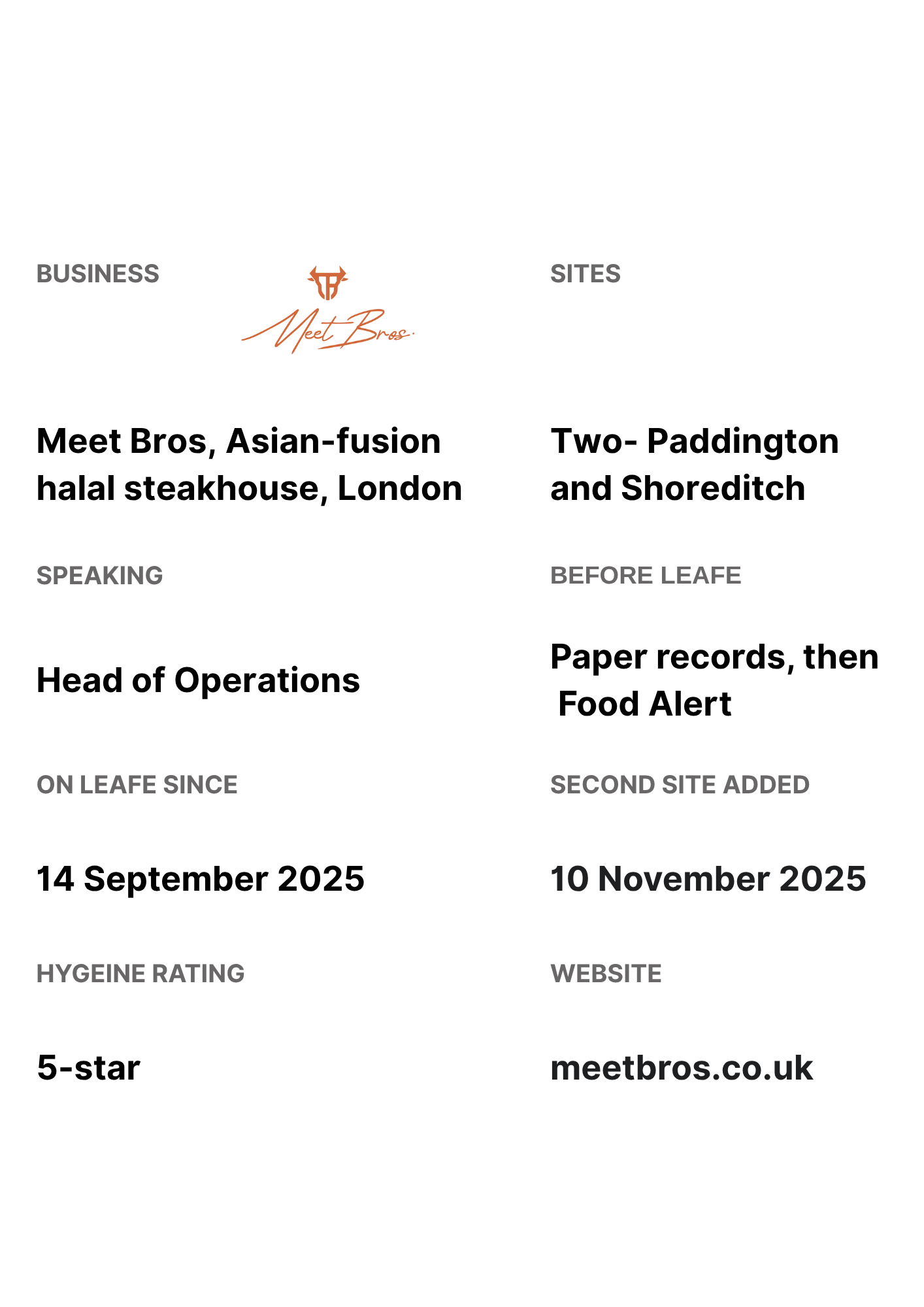
Meet Bros Stats
The inspector came in week three
There is no worse week to be inspected than the third one. The team is still learning the building, the suppliers are still settling down, and there is no history to point at because there has not been time to build any. Most operators spend that period quietly hoping nobody from the council walks in.
Meet Bros opened their second London site on 10 November 2025. The environmental health officer arrived two or three weeks later.
“The EHO came the other day, when I think it was the second or third week after we opened, and then we showed them the system that we use, and then they understood almost instantly.”
What makes an inspection long is rarely the cooking, it is the paperwork stage: finding the right folder, the right month, the right sheet, while somebody stands there waiting. Because every check in Leafe is stored against the date and time it happened, and can be pulled up as a date range on a tablet, that stage effectively disappears. There is nothing to locate, nothing to apologise for and nothing to explain.
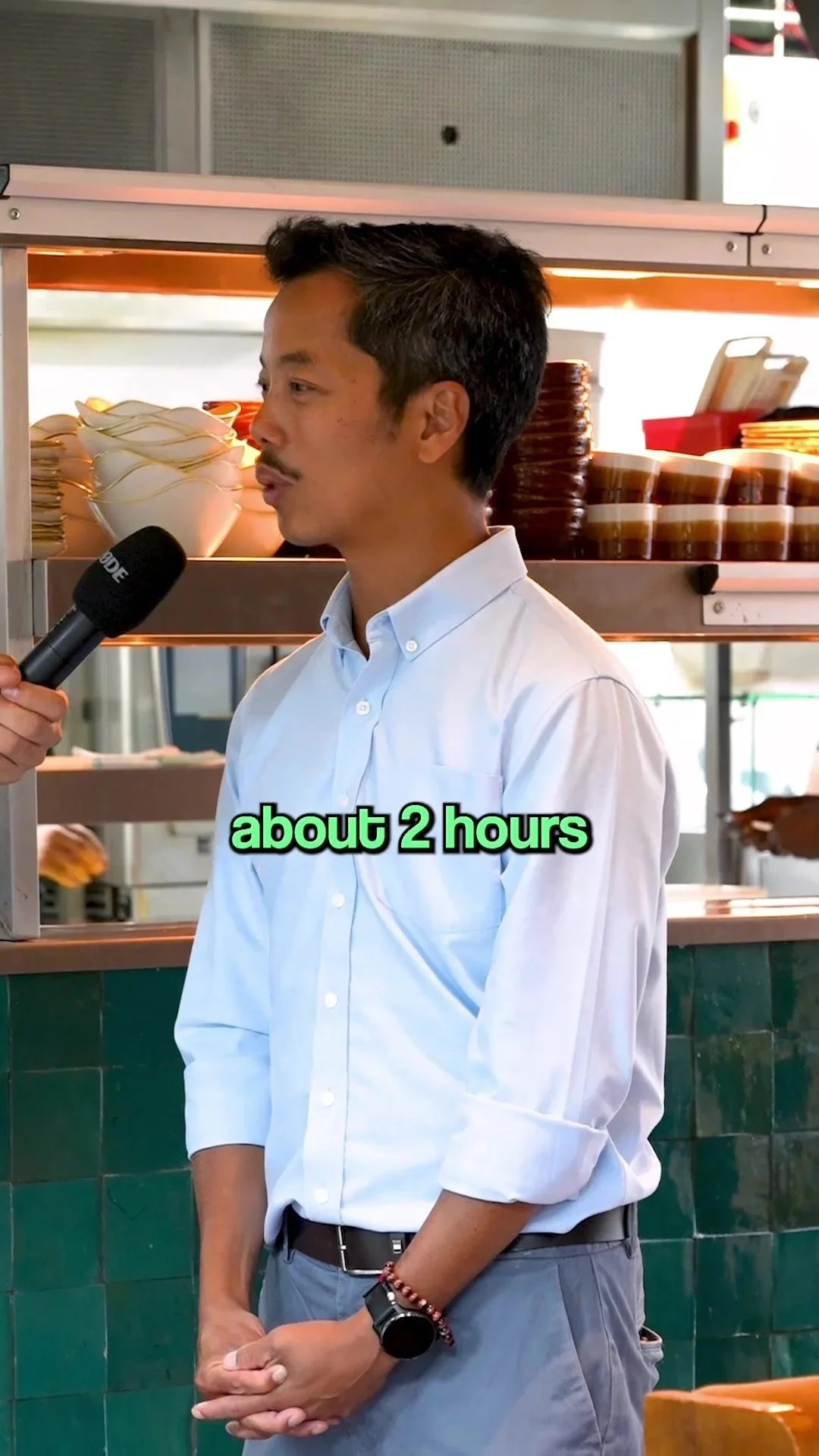
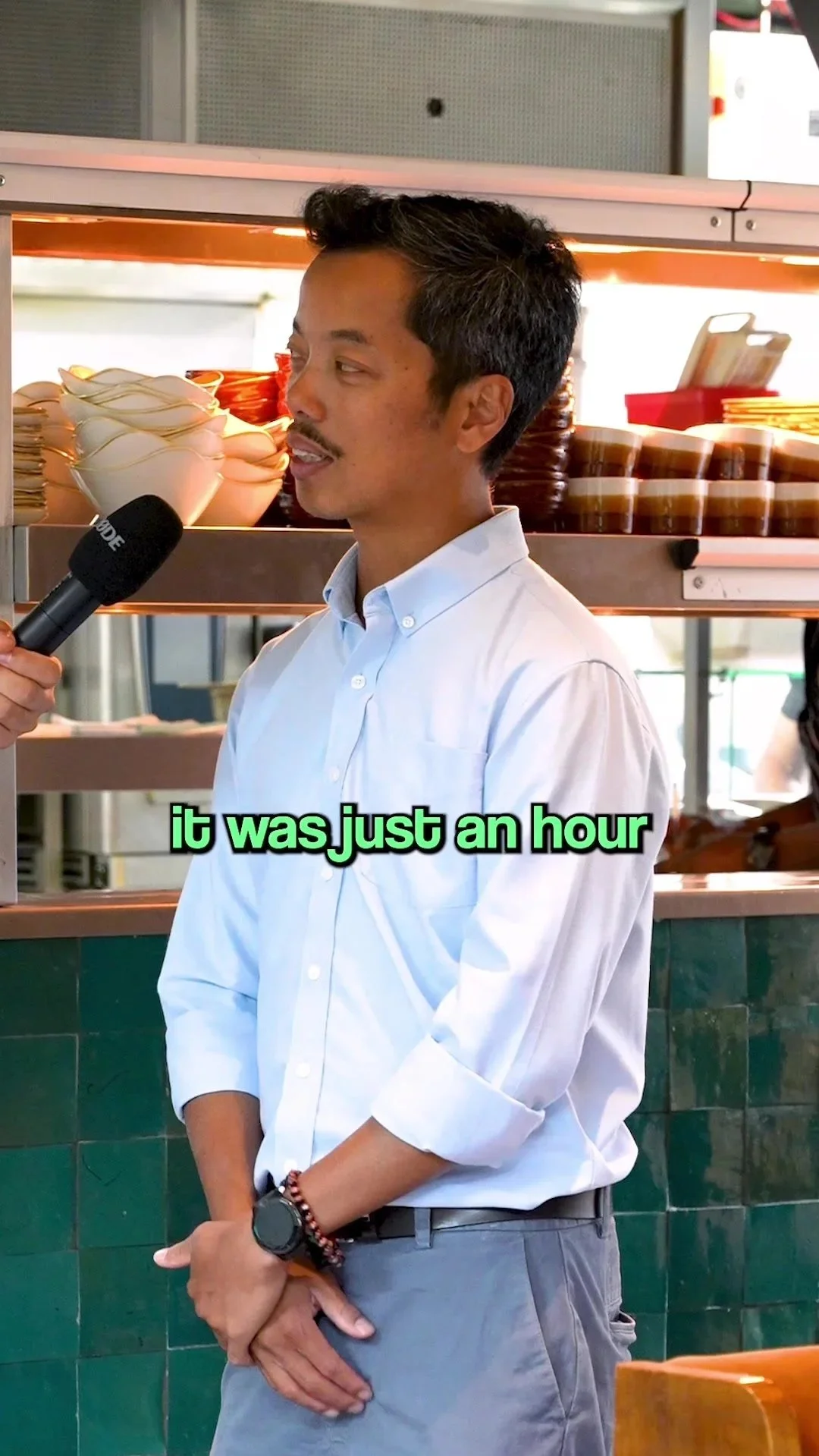
“Usually an EHO visit would take about two hours, but that visit when we have all the tools, it was just an hour.”
We put it back to him, because it is a big statement:
“So Leafe cut your EHO inspection by half?”
“Yeah, literally.”
Paper, Handwriting and the third one nobody says out loud
He got there by taking the book out of both kitchens first. Ask most operators what is wrong with paper records and you get two answers. He gives three, and counts them off.
The first are the ones everybody recognises. Paper lives in a room full of grease, oil and water, and it does not survive that for long. And a record is only useful if the next person can read it, which across a team with different handwriting is not a given.
“Number one, it’s paper. So especially, working in the kitchen, where there’s grease, where there’s oil, where there’s water, it can get damaged.”
01
“Number two, it’s illegible. So basically you sometimes cannot understand people’s handwriting, and then sometimes it can be construed.”
02
The third is a different kind of problem, and he says it without any particular drama.
“Number three, what I want to prevent is forgery.”
03
That is not a complaint about admin. A paper record can be written by anyone, at any time, about anything, and nothing in the page distinguishes a temperature taken at nine in the morning from one invented at elven at night. As due diligence, a book is only ever as good as the honesty of the person holding the pen, and everyone in the industry knows it.
This is the one thing Leafe does that a book structurally cannot. Every entry is made in the app at the moment of the check and carries the time it was made and the person who made it. There is no version of a record that can be created later, because there is nowhere later to create it. The output stops being paperwork and becomes evidence, which is exactly what an inspector is there to assess.
A Horrible way to keep records
Before that, there is the simpler failure. The book has to be somewhere, and somewhere is wherever the last person left it.
“A couple of times”. “Not fun. Its horrible. It’s just not worth it.”
Asked whether he would go back, he does not hesistate.
“Yeah, absolutely”. “No, never again.”
The fix is not a better filing system. It is not having a physical object at all. The record lives on the phone in the pocket of whoever is doing the check, and it is in one place for everybody, which means there is nothing to misplace, nothing to reconstruct after it goes missing.
What six months of records looks like on a trolley
The reason the inspection story matters is that he knows precisely what the alternative looks like. Asked what an EHO visit would have been like on paper, he does not describe stress. he describes logistics.
“We need to come up with like three different folders. Imagine you need to take out six months worth of record. That’s about six folders, you know, those thick ones that they use, and you have to bring it out”.
And the volume behind those folders is relentless, because the checks do not stop.
“Before we used to have sheets of paper. Weekly checklists, monthly checklists, daily checklists, temperature checks. And then if you have a lot of fridge, that means a lot of paperwork in terms of to record all your temperatures for fridge and freezer.”
Every fridge is a line, every line is a day, and by the time an inspector asks for six months you are carrrying the year out of a cupboard. Going digital does not reduce the number of checks. What changes is that the volume stops being physical: six months of records becomes a date range rather than a trolley, and producing takes a tap rather than an afternoon.
His first move on arriving was not to improve the filing.
“As soon as I got into Meet Bros, the first thing I did was just to take away all the unnecessary paperwork.”
“I need my chef to be cooking”
Coming off paper is only half the decision. The other half is what you come off paper onto, and he is unusually blunt about the standard software has to meet. It is not a feature list. It is a clock.
“I need my chef to be cooking. I don’t need my chef spending half a day going through Food Alert, going through into every single detail of ingredients and temperatures and everything. I need something that really can get it out of the way within the half and hour.”
This the objection that sinks most compliance software. A system that is thorough but slow just moves the burden from the folder to the screen, and the chef is still not cooking. Leafe is built as a sequence of prompts that follow the work the kitchen is doing anyway, rather than a database somebody has to go and fill in afterwards.
“Delivery comes in, you take a temperature,
01
and then you out it into the fridge,
02
03
and then you check the fridge temperature,
and then you bring it up.
04
“All of this provided by the Leafe app.”
The record is a by-product of the shift, not an extra task at the end of it. And because the app asks in order, the person doing it does not have to know the HACCP plan to follow it correctly.
“For me it’s important that the team understand the compliance, that every single ingredient has gone through the HACCP. And then Leafe helps me in that situation.”
Checking a kitchen you are not standing in
With two kitchens across London he cannot be in both, and the thing he needs to know each morning is not what the records say but whether they exist yet. On paper that means a phone call, taking somebody’s word for it, and finding the gap weeks later when the folder finally reaches him.
Leafe shows him what is outstanding right now rather than what was filed last month. He is not looking for records, he is looking for absences, and they surface without anyone having to report anything.
“…with one click of a button you can know exactly what is missing. And then you can communicate to your managers, have you done your checklist this morning? I can have real-time access to it.”
That turns the conversation with a site manager from an audit into a nudge, and it happens on the morning rather than at the end of the month. It is also the reason a second kitchen could go live in November on the same system as the first without a second way of working growing up around it.
What makes that survive contact with the two teams is that the thing they have to do is deliberately dull. There is no training programme and no judgment involved.
“You do one task, you press next, there’s another task, there’s another task. So it’s very very convenient, so anybody can actually use it.”
“There’s a person at the end of the call”
Asked what he would say to an operator still on paper, he starts where you would expect.
“It’s easier, it’s seamless, it’s faster, it gets the job done, and then it’s all compiled in a cloud so you can retrieve it whenever you want to.”
Then, unprompted, he makes a point about cost that most people in his position do not bother making, because it is not his problem. Independents stay on his book partly because the software built for groups is priced for groups.
“There are some independent restaurants that are still using the book, but Leafe can go into them with the right price range that they can manage”.
And he chooses to end on something that is not a feature for all. For a product sold on automation, the thing he singles out is that a human answers.
“Although, it’s all high-tech, AI and tablets and paperless, but if there’s an issue, one phone call, one email, someone will get to you as soon as possible.”
OPENING SOMETHING
NEW?
Start free for seven days, or talk to someone who has implemented Leafe in a kitchen before it opened
Watch the full conversation
