
“I CAN’T COME IN THE KITCHEN WITHOUT OPENING LEAFE, I CAN’T LEAVE THE KITCHEN WITHOUT OPENING LEAFE”.
A neighborhood restaurant kitchen in Chingford, on what changed when the paper book went in the bin. The team lead on how a new starter picks up the app in a week, and why nobody can close a shift on checks they haven’t actually completed.
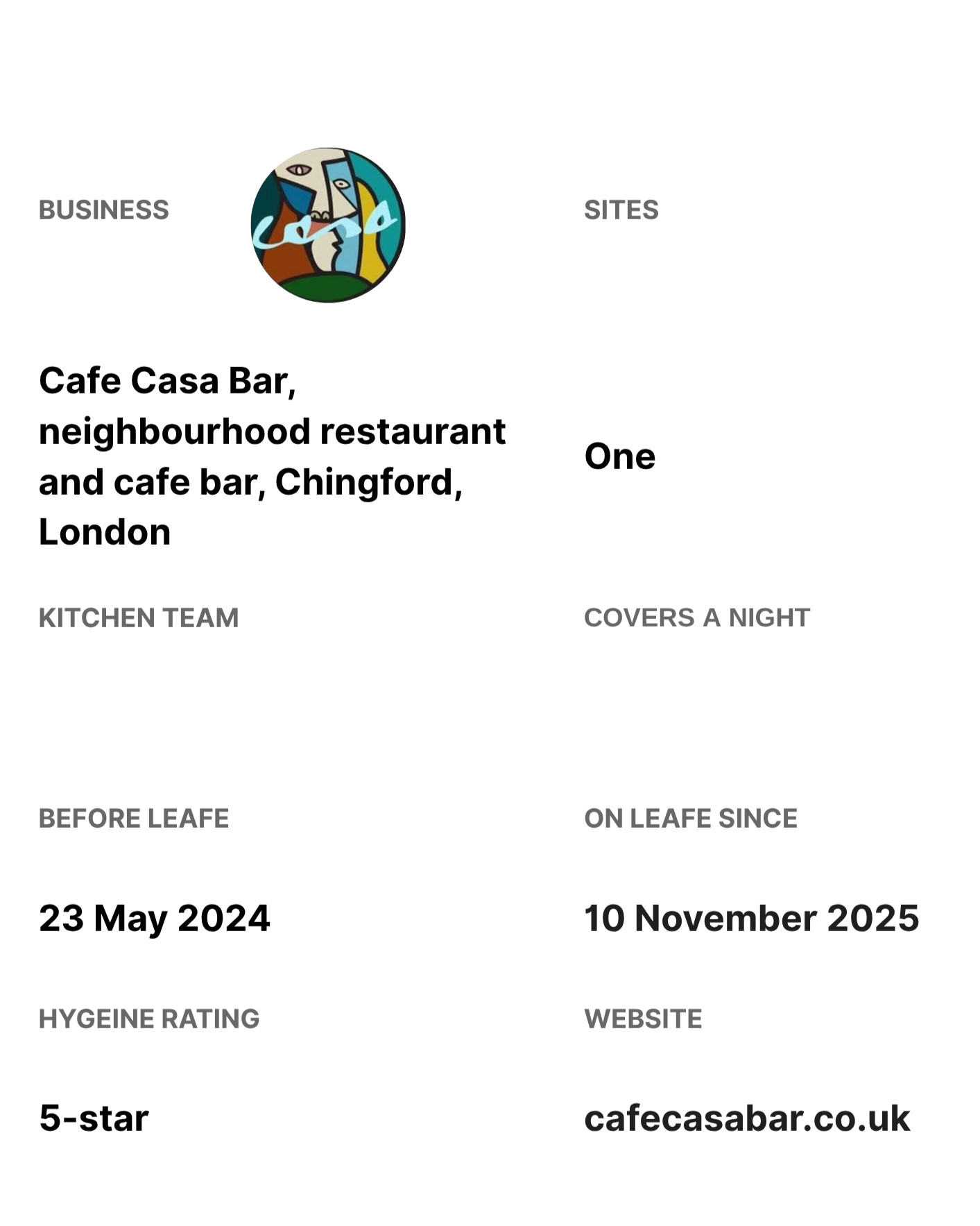
Casa Cafe Bar Stats
THE BOOK HAD A SPOT. THEN IT HAD ANOTHER SPOT.
Every paper kitchen runs the same unwritten filing system. There is a book, and there is a place the book lives, and the system holds as long as everybody puts it back. Across one person and one shift that works. Across a rota it does not, because the person who moved it is not the person looking for it.
The cost is small and constant. Somebody spends five or ten minutes at the start of the service finding out where yesterday ended up, and the checks that should have been logged at eight get logged at half past, if they get logged at all.
Leafe removes the object. The record lives on the phone already in the pocket of whoever is doing the check, and it goes to one place, so there is nothing to put back and nothing to lose. Nobody searches, and nobody starts a shift already behind.
“When you lose it, it’s a bit of a panic for everyone, and you don’t want to have that in the kitchen. It’s just a bit of a hassle. It takes an extra five, ten minutes, and you really don’t have that time.”

PAPERWORK IS A MEMORY PROBLEM
Ask why a check got missed and the answer is almost never that somebody refused to do it. It is that at eleven at night, after a long service, nobody remembered the fridge temperatures were still outstanding. Paper waits to be remembered. It has no way of asking.
What actually persuaded him was not a feature list. It was that the app carries the remembering. Leafe prompts each check at the point in the shift where it belongs, opening, closing, fridge temperatures, and shows what is still missing for the day. The job stops being a thing you have to hold in your head until the end of the night and becomes five seconds in the middle of it.
“It reminds you when to check, when you’re opening, closing, fridge temperatures. It’s all digital, it’s all on the phone. Takes five seconds to do.”
He describes the decision itself in a single line. There was no evaluation and no plot.
“It was basically a no-brainer”.
EVERY ITEM ON THE MENU, TWO CLICKS AWAY
Allergen questions arrive at the worst possible moment. Mid-service, from a table, about a dish somebody else prepped, and the answer has to be both right and immediate.
Leafe holds the allergen matrix for every item on the menu, in the same app the team already has open, so the answer is a lookup rather than a trip. He describes it as two clicks, and the thing he emphasizes is that it works when you are unsure, which is the only moment it needs to work in.
“We have every single item that we sell on the menu on there. Just two clicks away, we can check if a customer asks and we’re unsure. Yes, no, yes, no. It makes everything 100% safer”.
There is a second effect he mentions almost in passing, and it is how he came to know it by heart. The tool that was supposed to replace the knowledge ended up installing it.
“Because of the app, I’ve known every single allergen in the menu, and without that, that would have taken a lot longer.”
A step by step guide, not a filing cabinet
The thing he describes is not a record-keeping system. It is the running order for a shift. Turn on the machines, check the temperatures, check the stock, work down the list until the list is finished. The compliance is a by-product of following it, rather than a separate job that happens afterwards.
That matters most for people who have never seen the kitchen before. On paper, inducting a new starter means teaching them where things live: this folder here, that book there, this sheet on a Friday. It is knowledge that sits in somebody’s head and has to be transferred by talking. With the checklist on screen, induction is the screen. You hand the phone and the order of the shift already in it.
“If anyone new comes in the kitchen, it’s straight away you can just show them, this is what it is”.
He is specific about how long it takes, and the bar he sets is deliberately low.
“For anyone it will be super easy. As long as you can read, you can use the app. After a week you’ll be very comfortable.”
It also reaches past the kitchen. The same checklists cover the front of house and the areas nobody thinks of as part of food safety until as inspector asks.
“We can check the front, the back, everything, even the stuff that’s not in the kitchen. We can organize the entire shop floor.”
“20 out of 10”
An inspection is not really a test of your records. It is a test of whether the person on shift can produce the right record in the next ninety seconds, in front of someone with a clipboard. On paper that means knowing which folder, which section and which week, under pressure, which is why the stressful part of an EHO visit is usually the looking rather than the finding.
Everything in Leafe is stored against the date it happened and can be pulled up as a range, so producing six months of checks is a matter of opening the app and handing it over. He is clear that the change is not that his records got better. It is that he no longer has to perform.
“You don’t feel nervousness, you know everything’s on the app. You don’t need to even explain it, you just open the app: here’s what we’ve done from this date to this date. … When you have something that makes it so easy for you, that kind of takes the burden of your shoulders.”
Asked to score how prepared he feels now against the paper years, he does not pick a number on the scale he was offered.
“20 out of 10. It’s not even comparable”.
ONE QUESTION YOU STOP HAVING TO ASK
On paper finding out whether a check was actually done means asking people, one at a time, and taking their word for it. Every entry in Leafe carries who made it and when, so the question stops being a conversation and becomes a glance. In the kitchen, with several people across shifts, that is the difference between managing by trust and managing by evidence.
“You can check the documents whenever you want, you can check who signed them. If you need to check something, you don’t need to ask one by one, you can just see who’s done it, and you can go to them straight away. Which saves everyone time.”
Your living in the Stone Age
Asked about what he would say to a chef still running paper, he does not talk about compliance. He talks about standards, and about the app being the thing that holds them when attention runs out.
“You need to get this app. It’s not just there for you to tick off and forget about. It keeps everything in check, keeps your standards, gives you a routine. The percentage of mistakes you make decreases a lot with the Leafe app. it almost makes it impossible.”
And on whether it is for everyone:
“there’s not a single person in London that runs a kitchen that I wouldnt say dont use this app.”
YOUR KITCHEN COULD BE THE NEXT STORY
Start free for seven days, or if you’re running more than one site, talk to someone who’s rolled out Leafe across a group.
Watch the full conversation
